
Check the Manistee County Owner-of-Record Card
The owner-of-record card from Manistee County Equalization is the first record worth reading. It links an owner name and mailing address to the situs, parcel description, transfers, exemptions, tax maps, and parcel number. Check the tax year too. Note the local assessing unit as well.
| Owner name | Person, trust, estate, or entity carried on the current assessment roll |
|---|---|
| Mailing address | Destination for official correspondence; not proof of residence |
| Situs address | The physical location of the parcel |
| Parcel number | The cross-reference among roll, tax, map, and deed research |
| Last sale/transfer | A timing clue to compare with the recorder's newest conveyance |
| Deed reference | An instrument or liber/page clue when the live card supplies one |
The owner of record may not occupy the site. Keep mailing and situs fields separate. Neither field proves residency.
The roll's valuation and exemption data belongs to the parcel rather than proving who owns it, since a Principal Residence Exemption flag or agricultural classification supplies context about taxes. Treat those flags as background. They say nothing about where a person lives. For a current owner answer, the decisive comparison remains the roll name against the most recent recorded conveyance.
Read Manistee County's Three Search Routes
The official BS&A county portal visibly separates Address, Name, and Parcel Number paths.
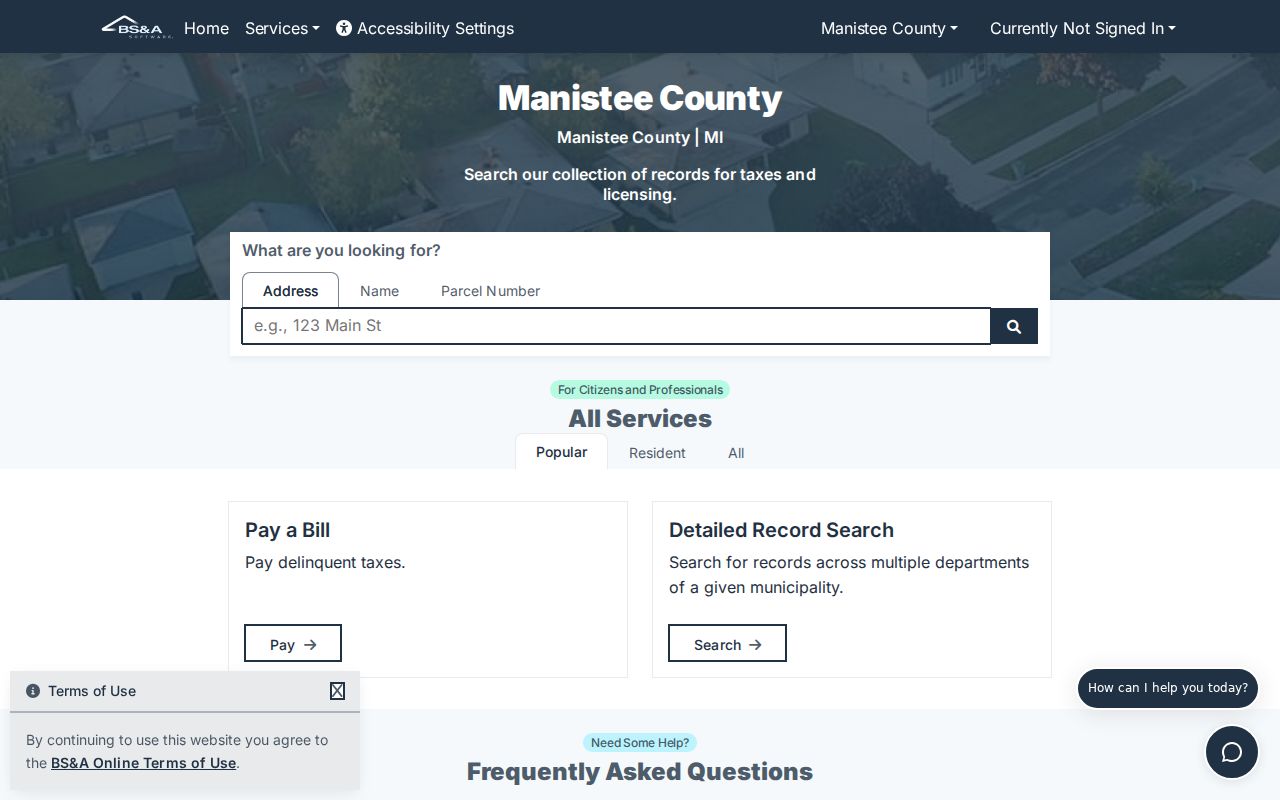
Pin the parcel down by address first. Manistee County also asks searchers to drop the 51 county prefix from a parcel number and to use one search option at a time. Save the number before comparing the displayed name.
How Current Is Manistee County's Owner Record?
No county source gives an exact lag in days between a closing and an assessment-roll refresh. Never promise an instant update. Instead, set the roll's transfer information beside the recording date in the land-record index. A deed recorded after the card's last transfer tells you to read that deed before naming the current owner.
The record lives in separate offices. Local assessing units build their own rolls, while Manistee County Equalization keeps the countywide roll and tax-map infrastructure. The Register of Deeds indexes conveyances. Even working normally, each can lag.
Write down the deed execution date, the recording date, the assessment transfer date, and the tax year as four separate facts. A closing can precede recording. A roll can keep the prior tax-year snapshot. When dates conflict, pull the indexed instrument instead of trusting a screen label.
Recent-sale gap. The newest recorded deed may be more current than the assessment roll, but neither source alone is a professional title opinion.
Verify Manistee County's Current Owner Against the Deed
Deeds land with the Manistee County Register of Deeds. Its index supplies the decisive second check on the name carried now.
- Read owner name, parcel number, situs, and transfer date on the county roll.
- Search the name and legal-description clues through Fidlar Tapestry.
- Open or request the most recently recorded conveyance and compare its grantee.
- If the grantee is an entity, check its filing without treating its agent as landowner.
- Owner of record
- The party named on an official current roll.
- Assessment roll
- The local property and valuation record.
- Recording lag
- The interval before connected systems reflect a transfer.
- Situs
- The physical property address, distinct from the correspondence address.
Compare Current Tax and Ownership Dates
The Treasurer holds tax histories, amounts due, delinquency, redemption, and foreclosure details. A tax-view name can be older than the deed. Compare the tax year, sale date, and recording date first.
Taxable value may uncap after transfer under Proposal A. That consequence never decides title. The Manistee County property value guide explains assessed and taxable values. BS&A keeps current and delinquent taxes in separate views. Never blend those dates.
Note: A tax-bill name is evidence tied to a tax year, not a substitute for the newest recorded conveyance.
Manistee County's BS&A home runs current and delinquent tax functions as separate services. Treating those views as one live owner database blurs both date and purpose. Cite the roll year and deed recording behind it. That keeps the answer reproducible later.
Verify a Current LLC, Trust, or Estate
A Manistee County roll may carry an LLC, corporation, trust, or estate. Michigan LARA's MiBusiness Registry route can reveal entity status. It also lists registered office or agent, formation details, and annual statements. It explains the entity, not its ownership. No officer or agent becomes owner by that route.
For a trust, read the deed vesting and the trustee's capacity. For an estate, look for a recorded probate instrument. A certified court order or separate death certificate can also serve. Manistee County notes that an attached death certificate is not accepted as an exhibit. It must be recorded separately.
The Manistee County Clerk holds vital records and court materials. The 19th Circuit Court search can add case context. Those records may explain why a fiduciary appears. They never replace the deed, so keep the identity check and the title check separate.
Check the Present Owner Without the Web Portal
Contact Manistee County Equalization with tax roll questions. The Register of Deeds public vault sits at 415 Third Street, Manistee, open Monday through Friday, 8:30 a.m. to noon and 1 to 4 p.m. Call 231-723-2146 or mail a request with payment and a stamped, self-addressed envelope. Include the parcel number, possible names, a transfer date, and any instrument clue.
Staff will run a simple search covering up to 20 years, but they do not perform title searches. Real-estate copies cost $7 for two pages, then $1 per page after the first two, and certification runs $5 for an entire document. When a county record you can describe is missing from the usual channels, use the written or email county FOIA channel.
A strong request names the parcel, local unit, address, possible owner spellings, record type, and a narrow date range. Michigan FOIA gives a public body five business days to respond and allows a ten-business-day extension. Try the ordinary copy channels first. FOIA is the fallback for a described existing record, not a demand that staff determine ownership.
The public vault exists under MCL 565.551, so an in-person researcher may inspect and copy the indexed documents directly. Bring the parcel card, spelling variants, and a written chronology. That preparation pays off when a trust suffix, middle initial, former business name, or survivor notation leaves a single-name result ambiguous.
The county publishes no guaranteed refresh schedule for its current-record interfaces, and not every Tapestry field is documented. Note those limits in your own records. A reliable answer separates what the live screen displayed from what the copied deed actually stated, rather than filling a portal gap with an assumption.
If you need a mailed copy, enclose the stamped envelope and payment. The county releases copies after payment and will not forward an open-ended research request to another office. A narrow instrument request gets evaluated faster and preserves the exact evidence behind the present-owner conclusion.
Use the Manistee County Mailing Field Responsibly
A mailing address is an official correspondence clue, nothing more. It might be a post-office box. It might be a business office, a trustee's address, or a designated contact. Michigan's Safe at Home program shields eligible participants behind a substitute address. Never try to defeat that protection. Never assume an alternate address marks a residence. For purchase inquiries, boundary coordination, estate research, or correction requests, send a neutral written message to the published destination. Always include the parcel number, so a same-name owner knows which land you mean.
Lawful use. Public owner information supports legitimate property matters; never use it to stalk, harass, intimidate, or harm a person.