
Compare Manistee County's Recorded Value Types
True cash value anchors Michigan's assessment framework. It means the property's usual selling price on the open market. Assessed value is simply half of that figure. Taxable value follows Proposal A instead, and it can stay below assessed value until a transfer or another statutory event resets its path.
| Figure | What it means | Record source |
|---|---|---|
| True cash value | Michigan's market-oriented benchmark for usual selling price | Assessment framework and roll context |
| Assessed value | Normally 50% of true cash value | Local assessment roll / BS&A |
| Taxable value | Capped tax base, subject to Proposal A rules and possible uncapping | Assessment and tax record |
| Sale price | Amount associated with one transfer, not an automatic reassessment formula | Deed and transfer history |
A sale supplies market evidence. Yet Michigan does not set taxable value at half the sale price. Match like years. Preserve each label.
Assessment records may split value into land and improvement parts. Comparing those parts without the roll year invites error. Classification, exemptions, transfer flags, and local equalization context belong beside the figures. Owner name is incidental here. This page interprets numbers rather than deciding title or computing a final tax bill.
Open Manistee County's Value and Tax Views
The BS&A current property-tax route may require municipality context in a live session.
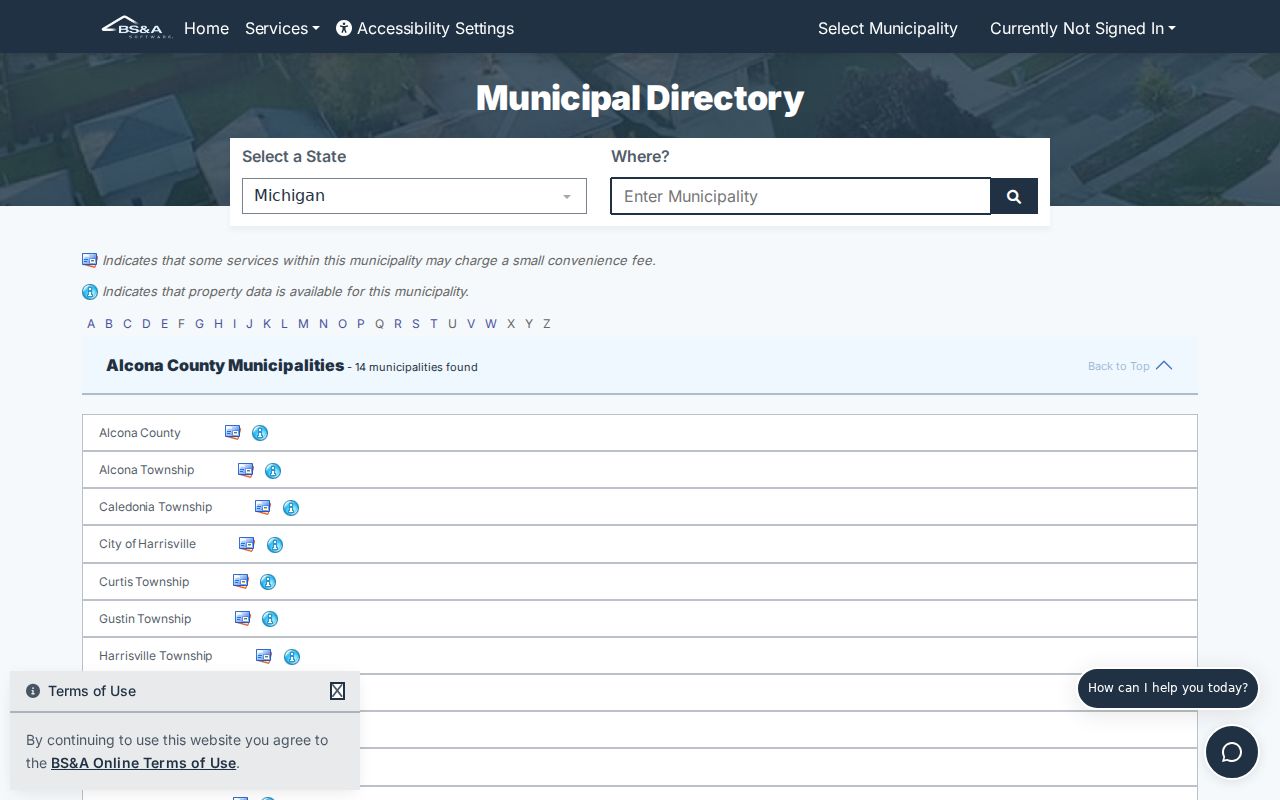
The county portal splits its lookups into Address, Name, and Parcel Number searches. It also separates current, delinquent, and detailed tax views. Write down the parcel number, tax year, and assessing unit before comparing figures across screens.
County instructions say to drop the 51 prefix on parcel searches. Use one search option at a time. If an address search comes up empty, the parcel number is the safer fallback. Some owners have nearly identical names. A mailing address can look alike across two local units too. Resist merging values in those cases.
Estimate a Manistee County Property Value from Records
Start with the official county Property Search, not with an isolated sale advertisement or an unnamed estimate.
- Locate the parcel by site address and retain its parcel number.
- Read assessed and taxable values with the roll year and local unit.
- Check the transfer history and newest recorded deed for sale context.
- Compare genuinely similar property geography and status, not merely a nearby address.
- Assessed value
- The constitutionally framed 50%-of-true-cash-value figure.
- Taxable value
- The capped figure used in the tax calculation, subject to uncapping rules.
- True cash value
- The Michigan term for usual selling value.
- Comparable sale
- A relevant transaction clue, not a guarantee of another parcel's price.
Understand Transfer Uncapping in Michigan
Proposal A caps annual growth in taxable value. A long-held parcel can carry a taxable figure far below its assessed value. Transfers change that. After a transfer of ownership, taxable value generally uncaps the following year under Michigan Treasury rules. Exemptions and exact circumstances shape the outcome. That reset explains why a buyer's later tax base can differ sharply from the seller's last bill.
Two official sources carry the paperwork. Turn to the Michigan Treasury ownership-change guidance and the county Property Forms page. These cover transfer affidavits and Principal Residence Exemption materials. They also carry agricultural forms, split applications, and Board of Review petitions.
Note: A transfer and its tax consequence should be verified from the deed, affidavit, and correct assessment year.
Use Manistee County Land and Lake Studies
County Equalization runs studies and pushes toward uniform assessment across local units. Manistee's geography complicates the grouping. Lake Michigan frontage, Manistee Lake port and industrial context, Portage Lake and M-22 parcels, and village lots never form one comparison set. Inland acreage stands apart too. Waterfront access changes things. Zoning overlays, parcel size, improvements, and shoreline constraints can shift the analysis too.
Onekama village and township take distinct zoning routes around Portage Lake. Eastlake's official map lays out M-55, the railroad, water, named streets, and several zoning categories. Jurisdiction matters first. Confirm land-use context before treating physical proximity as value similarity.
Manistee city's industrial and port setting around Manistee Lake differs from its historic downtown. Its residential additions sit in another category as well. A postal "Manistee" or "Onekama" address proves little. Postal geography reaches past incorporated boundaries. Confirm the assessing unit. Confirm the school district and the parcel geography shown in the official record.
Compare the Latest Sale Without Equating It to Value
The Register of Deeds preserves the recorded conveyance along with party, date, instrument, and legal-description clues. A recent arm's-length sale can inform value research. Not every deed does. Family transfers, trusts, estates, and quitclaims can make the stated consideration a weak comparison.
Match the sale to the right parcel. Read the deed type next. Then compare roll year and property status before drawing any conclusion. The property-value question is what the official figures mean; the deed records page handles document retrieval and recording detail.
Review Manistee County's Assessment-Appeal Trail
A value disagreement starts locally. Take it first to the assessing unit and the Board of Review. The county's forms page links Michigan Form 618 and related property forms. The state Board of Review instructions identify current forms and procedures. Deadlines vary by municipality and year. No single countywide filing date applies.
Assemble the notice, parcel card, photographs, property facts, comparable evidence, and any correction to classification or exemption status. An appeal record explains the contest. It is not a sale appraisal.
County Equalization works toward uniformity and maintains transfers, maps, exemption and uncapping information, but the local assessing unit establishes the individual roll. Start with the unit named on the assessment notice. The Michigan Tax Tribunal sits at the end of the path. It matters only through the applicable review and appeal process, so verify the current procedure rather than relying on an old calendar.
Separate Delinquent Taxes from Property Value
Delinquent tax questions and property value questions often arrive together. The County Treasurer is the office that separates them. The Treasurer keeps tax histories, amounts due, delinquent real-property taxes, redemptions, foreclosure records, and tax-history certifications. Michigan moves delinquent parcels through a defined sequence. Delinquency comes first, then forfeiture, then foreclosure, over multiple years. Those records matter enormously to a buyer's diligence and true net cost. But a tax amount due is not a market value. It is not an assessment either.
Exemptions follow the same logic. A principal residence exemption or qualified agricultural status changes how a parcel is taxed. It does not create a market estimate. Read the labelled fields carefully. Confirm the effective years behind each figure.
The state's official foreclosure guidance lays out the same three-stage timeline. A parcel caught in that process can carry redemption costs. It can also carry an auction history that reshapes a buyer's diligence. Distress alone supplies no universal discount formula. Check the Treasurer's status and the state timeline on their own terms. Keep those apart from the assessed value.
Tax-history certification is a separate Treasurer service. It establishes official tax status for a stated period. That is far more reliable than inferring delinquency from an old record. A tax-foreclosure auction result works the same way. It reflects that proceeding's terms and date, not a standing county appraisal of comparable parcels.
Know What Manistee County's Assessed Value Cannot Do
An assessment exists to administer property taxes across a roll. That is its whole job. It is not a guarantee of sale price. It is not a boundary survey, a building-condition report, or a title opinion. A renovation, a storm, or a recent transaction can all land after the assessor's figures do. A market shift can, too. For a transaction-specific opinion, bring in professional valuation and inspection work.
When a portal record is missing, go straight to the source. Contact the local assessor or Manistee County Equalization with a focused request. Include the parcel number, situs address, local unit, and tax year. Name the exact value field needed, too. Keep the other channels straight, too. The Treasurer handles tax history and amounts due. The Register of Deeds holds the sale instrument itself.
Value vs. price. A Manistee County assessed value is not a promise of sale price; use the roll as one dated official record among several.