
Fields Inside Manistee County Property Tax Records
A tax record in Manistee County is not one flat bill. The assessment roll carries the parcel description and valuation fields. The Treasurer keeps tax histories, amounts due, delinquency, redemption, and foreclosure details. County Equalization maintains the countywide roll and map infrastructure. Yet it cannot change an individual assessment. That decision starts with the city or township assessing unit.
| Field | What It Shows | Where |
|---|---|---|
| Assessed and state equalized value | Tax-roll value tied to Michigan's assessment level | Local assessor and Equalization roll |
| Taxable and capped value | The value used in the tax calculation under Proposal A rules | Assessment roll and BS&A |
| PRE or agricultural percentage | Whether a documented exemption applies | Assessment roll and Equalization |
| Transfer and uncapping | Date of ownership transfer and its taxable-value effect | Assessment roll |
| Current or delinquent amount | Tax history, amount due, payment, forfeiture, or redemption status | County Treasurer |
Michigan pegs assessed value at 50 percent of true cash value. True cash value is the usual selling price at assessment time. Taxable value moves on a separate track. It normally rises by inflation or 5 percent, whichever is less. A transfer uncaps it the following year. A deed's sale price reflects one transaction. It is not the same figure as either assessed or taxable value.
Manistee County BS&A Tax Search Keys
For current and delinquent tax searches, the county links BS&A Online. Its Manistee County page offers Address, Name, and Parcel Number tabs. No account is needed for a public search. BS&A does note that a resident account can claim properties. It allows up to five properties free of charge. Search one key at a time, and save the parcel ID from the result.
| Search mode | Input shown | Best use |
|---|---|---|
| Address | Street-address text, illustrated as “123 Main St” | Start from a known site address |
| Name | Owner text, illustrated as “Smith, John” | Find parcels indexed to a person or entity |
| Parcel Number | Masked as 99-999-999-99 | Match the exact tax account across years |
The service menu also lists Detailed Record Search. It additionally offers Current Tax Search, Pay Delinquent Taxes, and Delinquent Tax Search. The county publishes an assessment-roll inventory of these tax services. Treat that inventory, not assumed screen labels, as the dependable guide. That inventory shows what each search returns. The BS&A current tax route is the county's web entry into that search.
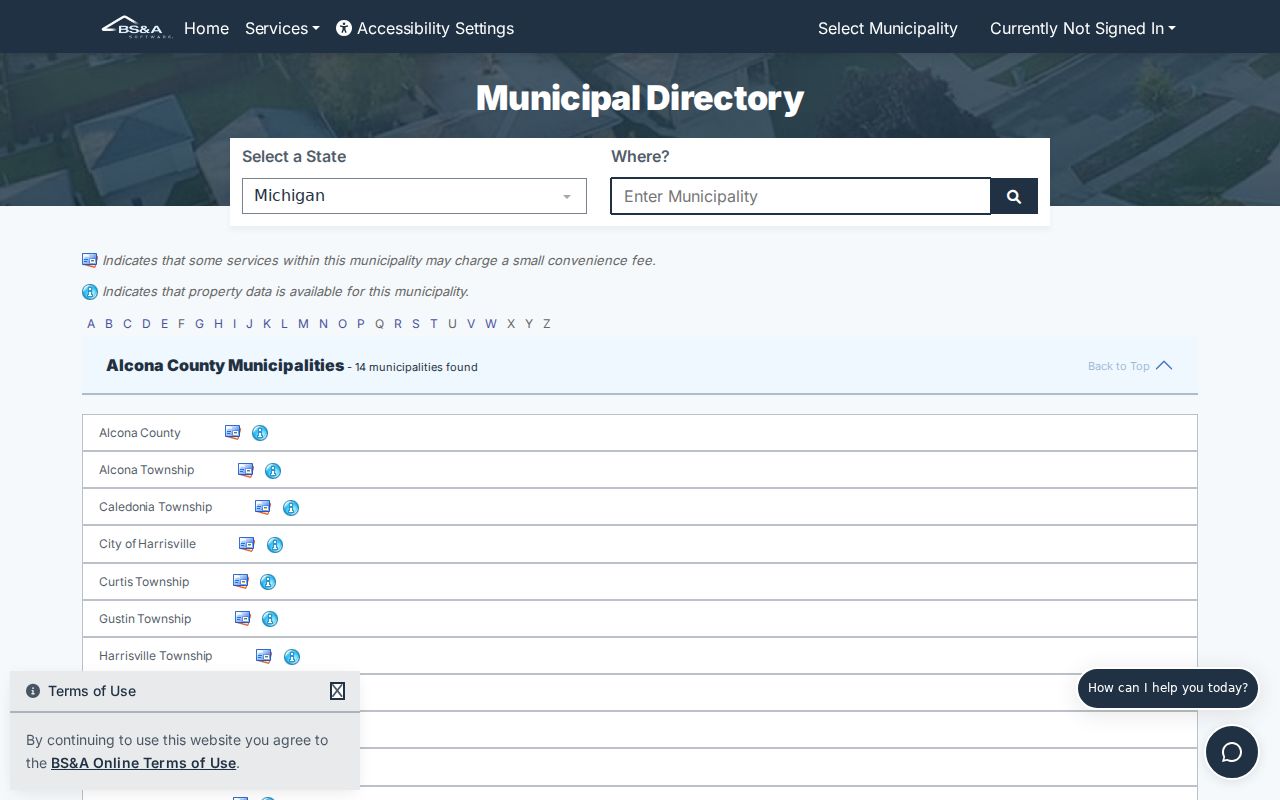
The official BS&A entry page displays the route to the tax search. Parcel-specific fields appear only inside the live search after its verification step. Note: County instructions say to omit the leading 51 when entering a Manistee parcel number in the LIAA property search.
Why Manistee County Taxable Value Can Trail Assessed Value
Proposal A explains one of the most common surprises in Manistee County property tax records. Assessed value tracks the assessor's view of true cash value. That figure sits at the constitutional 50 percent level. Taxable value is capped year to year. Two similar parcels can show similar assessed values yet different taxable values. Their transfer dates and exemption histories differ.
- Assessed value
- One-half of the assessor's true cash value estimate after equalization.
- Taxable value
- The value to which tax rates are applied, subject to the Proposal A cap and transfer rules.
- Mill or levy
- A rate applied by the relevant local, school, and other taxing jurisdictions.
- Tax lien
- A public claim arising from unpaid property tax, tracked through delinquency and foreclosure records.
A transfer can uncap taxable value the following year. County Equalization maintains the transfer and uncapping data, and the Property Transfer Affidavit L-4260 documents the event. For a fuller explanation of each value, see the Manistee County property value guide.
Manistee County Forms Behind the Tax Roll
The county's Property Forms page gathers the forms that can change how a parcel is described or taxed. You will find the Property Transfer Affidavit. There are also Principal Residence Exemption claim and rescission forms, a conditional PRE rescission, the Disabled Veterans Exemption, and the Qualified Agricultural Exemption. The page adds an address change, tax-description combination, and property split requests.
Form 2368 is the PRE claim, and Form 2602 rescinds that exemption. Form 4640 handles a conditional rescission. Form 5107 covers the disabled-veterans exemption, and Form 2599 concerns qualified agricultural property. The local assessor decides eligibility under the applicable rules. Equalization then records the percentage or flag in the county infrastructure. Check the roll after filing. Do not assume an exemption from occupancy or past bills.
The official county form directory shows this group of assessment documents.
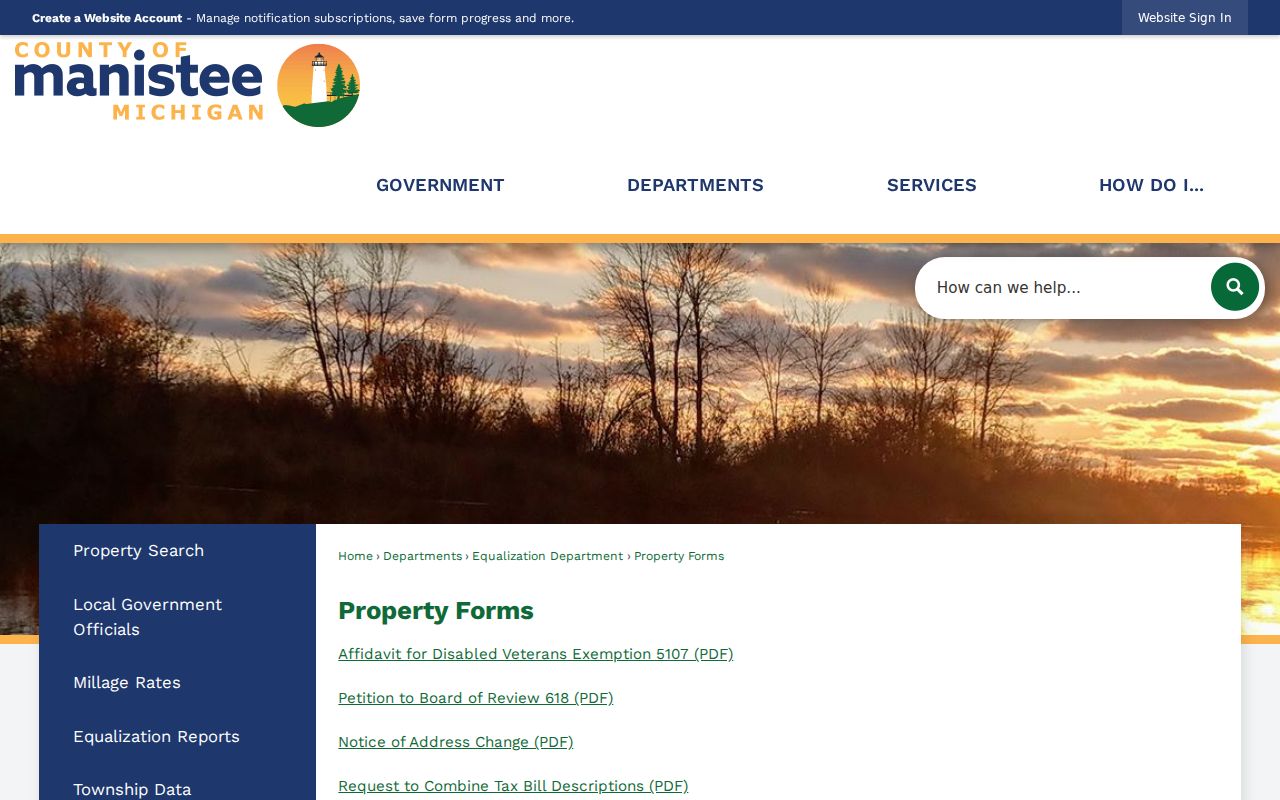
The directory separates transfer, exemption, address, combination, and appeal forms before any filing begins. Note: A Treasurer mailing-address change can update where a bill goes, but it cannot change the indexed owner name.
Follow a Manistee County Tax Bill from Roll to Treasurer
A careful lookup keeps assessment and collection records separate. Start at the county's Property Search entry page or BS&A, capture the exact parcel number, then use the tax services tied to that account. If the web route fails, Equalization can supply roll fields and the Treasurer can provide tax history or balances.
- Search by address, owner name, or parcel number and open the matching parcel.
- Compare assessed, state equalized, capped, and taxable values on the assessment roll.
- Check the PRE or agricultural percentage and any transfer or uncapping entry.
- Open current or delinquent tax search and review the tax history, amount due, and payment status.
- Ask the Treasurer directly about redemption, foreclosure, or a tax-history certification when the online result is unclear.
The Treasurer sits at 415 Third Street, Manistee, and answers at 231-723-3173, Monday through Friday, 8:30 a.m. to 5 p.m. Equalization shares the same street address. Call 231-723-5957 during the same weekday hours. Those counter and phone channels matter whenever reCAPTCHA, municipality context, or an older tax year interrupts the online path.
Delinquent Manistee County Property Tax Records
The Manistee County Treasurer maintains delinquent real-property tax records. It also handles notices, forfeiture redemptions, foreclosure information, and tax histories. That makes the Treasurer, not the assessor, the office to contact. Reach out once a bill moves beyond ordinary local collection. BS&A offers both a delinquent search and a payment route. The county's Treasurer page presents those tax-history and delinquency duties.
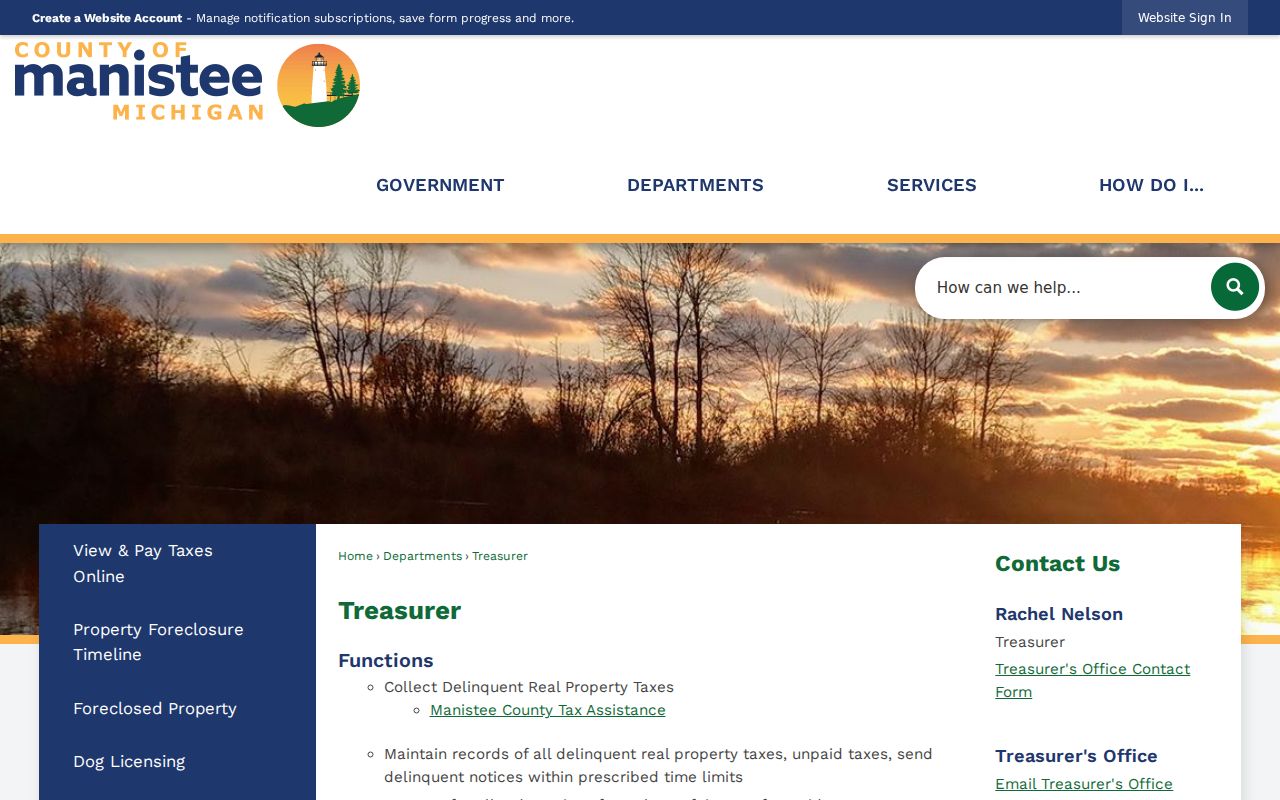
The Treasurer's page covers billing and collection. Local assessors and Equalization handle the valuation work. Michigan runs a three-year delinquency, forfeiture, and foreclosure process. The state foreclosure timeline explains each statutory stage. The county record supplies the parcel-specific facts. Balances shift. Interest, fees, redemption status, and deadlines can all change. Confirm any amount with the Treasurer before paying or buying.
Do not infer a sale from a delinquent bill. Tax history shows the collection process; confirm any foreclosure disposition and later ownership in the official county records.
When a Local Charge Joins a Manistee County Bill
Not every line on a Manistee County tax bill comes from the basic assessed-value calculation. The Village of Onekama shows why. There, unpaid sewer charges can become a special assessment on the summer bill. So identify the assessing unit.
The county property-search instructions note that a tax estimate also needs the township and school district. A Manistee mailing address proves little. A village ZIP proves little either. Use the tax card's fields instead. Its assessing-unit and school-district entries identify the local unit, and the relevant municipality can explain any special charge the county roll alone leaves out.
Contest a Manistee County Property Tax Assessment
Michigan's March Board of Review is the normal local route for challenging assessed and tentative taxable value. July and December boards are narrower. They cover clerical error, mutual mistake, and exemption fixes. Read the assessment notice first. Then contact the local assessor named for the parcel and file the petition within that unit's published schedule.
Michigan Form 618 asks for the parcel number, classification, the Board-of-Review assessed and taxable values, and the owner's claimed true cash, assessed, and taxable figures, plus an explanation, signature, and prior Board action. Evidence carries the appeal. Sales, condition evidence, measurements, and comparable assessments should back the claimed figure. The Michigan Tax Tribunal is blunt. The petitioner bears the burden of proving true cash value and taxable value.
Appeal window. Use the March Board of Review for an ordinary value dispute and verify the exact meeting and filing dates with the parcel's local assessing unit.
County Equalization studies land and lake values, sales, appraisal data, and economic conditions to keep assessment levels uniform. It cannot revise one parcel's assessment. That division of labor shapes every appeal. A challenge goes first to the city or township Board of Review, not to the county mapping office or the Treasurer.
Offline Access to Manistee County Tax History
Online tax records are a start. Equalization helps by phone and in person with parcel descriptions, acreage, values, transfers, exemptions, and map references. The Treasurer handles the money side. Counter and phone questions about tax histories, delinquency, redemption, foreclosure, and certifications all land there. Some records never reach a portal. Request those in writing under the Michigan Freedom of Information Act.
A good written request names the parcel number, street address, assessing unit, record type, and date range, and Manistee County accepts it written or emailed through the Controller/Administrator's Office. The clock runs quickly. Michigan FOIA generally gives a public body five business days to respond and permits one ten-business-day extension, with statutory fees possibly covering search, review, redaction, copying, and mailing.
Archived context calls for other hands. The Register of Deeds can supply recorded instruments, and the county library's local-history resources may explain an old street or owner name. Neither replaces the official record. But each can clear a blocking mismatch.